
by Alexandra Indra Kruse for the Carl Kruse Blog
Jellyfish are mesmerizing. Transparent, luminous, drifting through the water without any apparent urgency. Less earthly animals and more like visitors from another world. If any aquariums display them they get a room or a gallery. In Pompano Beach, Florida, they got an entire museum.
The Jellyfish Museum, which opened in March 2026 just north of Fort Lauderdale, is the creation of Ukrainian aquarium developers Alex and Yana Yanovsky. Years earlier while operating aquariums in Europe, the Yanovskys noticed that visitors behaved differently around the jellyfish tanks. People slowed down. They lingered. Everyone was captivated by the creatures’ strange, rhythmic movement. I know I was when I first saw jellyfish in an aquarium.
Yana Yanovsky wondered whether jellyfish might be the stars of their own attraction.
The couple eventually created a jellyfish museum in Kyiv. Then Russia’s full-scale invasion of Ukraine in 2022 upended their lives. They left the country, eventually settled in Florida and instead of abandoning the concept they revived it there.
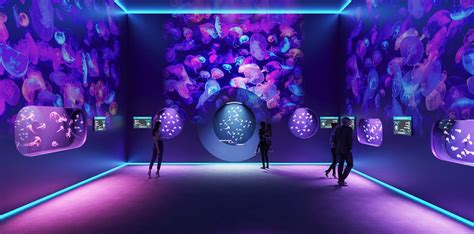
The new museum occupies an unlikely setting in a former Wells Fargo bank near the Pompano Beach fishing pier. The old commercial space has been transformed into something deliberately otherworldly. The roughly 10,000-square-foot museum is dark, atmospheric, with more than twenty specialized tanks lit in shifting colors. About twenty species are displayed. Moon jellies, Japanese sea nettles, spotted jellies and the curious upside-down jellyfish found around Florida’s mangroves.
The effect is like entering a slowly moving underwater gallery. Jellyfish float against glowing backgrounds while projections, darkness and carefully controlled lighting turn the animals into living sculptures.
Yet it was another aquarium thousands of miles away in California that helped make this kind of experience possible.
The Monterey Bay Aquarium (also revisited here) transformed the way we see jellyfish. When the aquarium began exhibiting jellyfish in the 1980s, and later opened a permanent jellyfish gallery in the 1990s, jellies were still something of an oddity to the public. They were difficult to keep, difficult to breed and not generally considered headline attractions.
Monterey changed that.
Its aquarists became pioneers in jellyfish husbandry, developing specialized circular tanks and breeding techniques that allowed fragile jellies to be kept successfully through their entire life cycles. Just as importantly, Monterey recognized something that now seems obvious: jellyfish are extraordinarily beautiful when presented properly.
Placed against deep blue or brilliantly illuminated backgrounds, their translucent bells and trailing tentacles suddenly became theatrical. The aquarium treated them not merely as biological specimens, but if we can say it, as works of art.
That approach was enormously influential. Jellyfish galleries began appearing in aquariums around the world.
In that sense, the museum in Pompano Beach feels like the logical next step in an idea Monterey helped popularize.
The two experiences, however, are quite different.
Monterey Bay Aquarium is a vast institution devoted to the ocean as a whole. Its jellyfish displays sit alongside enormous kelp forests, sea otters, sharks, open-ocean exhibits, deep-sea creatures and serious scientific research. The aquarium has decades of expertise behind its jellyfish program and remains one of the most sophisticated marine institutions in the world.
Pompano Beach is much smaller and far more intimate. There are no sea otters waiting in the next gallery and no giant kelp forest around the corner. Jellyfish are the entire point.
That narrow focus may actually be its greatest strength.
At Monterey, jellyfish are one extraordinary chapter in a much larger story about the sea. In Florida, they are the whole story. You can spend the visit simply watching them pulse and drift from tank to tank, noticing how radically different one species can look from another.
Someone who has visited the Monterey Bay Aquarium should therefore not go to Pompano expecting a miniature version of Monterey. The Florida museum does not have Monterey’s scale, scientific infrastructure or institutional history.
What it offers instead is something more concentrated: the strange beauty of jellyfish stripped of almost everything else.
And perhaps the most compelling part of the museum is the story behind it. An idea that began in Ukraine, interrupted by war and displacement, carried across the Atlantic and recreated inside an abandoned Florida bank.
That seems oddly appropriate for a museum devoted to creatures that have survived hundreds of millions of years by doing essentially the same thing they do today: drifting, adapting and somehow continuing on.
===========================
The Carl Kruse Nonprofits blog homepage is at https://carlkruse.org
Contact: carl AT carlkruse DOT org
Other articles in the blog include Is The Way We Study History Wrong. For those interested in organizations that help the marine environment please check the work of the New York Marine Rescue Center.
Find Carl Kruse on his other blog.